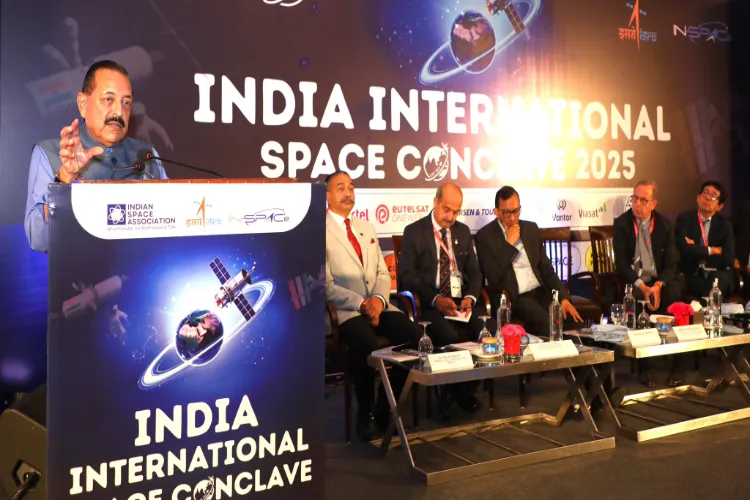
Need to change mindset and enhance private investment in India’s space sector: Jitendra Singh
Context mode is active. Hover over any highlighted term to see its definition. Click a nested term to go deeper.
Union Minister Jitendra Singh has issued a clear directive: India's burgeoning space sector must aggressively pursue a mindset shift and dramatically scale up private investment to sharpen its global competitive edge. This comes as the sector, fueled by significant government reforms, has already attracted over $600 million in private capital over the last five years and now boasts more than 400 startups, marking a transformative period for what was once a state-monopoly domain. The urgency underscores India's ambition to expand its space economy fivefold, from an estimated $9 billion today to $45 billion within the next 7-8 years. The stakes are rising with critical policy instruments like the Indian Space Policy 2023 now in full swing, actively enabling Non-Government Entities (NGEs) across the entire space value chain. India's space regulator, IN-SPACe, is at the forefront, not only channeling funds through a Rs 500 crore Technology Adoption Fund to innovative startups like Astrobase, SatSure, and TM2SPACE, but also initiating the crucial Transfer of Technology (ToT) for ISRO heaviest operational rocket, the LVM3, to private industry. This strategic divestment by ISRO allows the national agency to pivot towards next-generation deep-space and human spaceflight missions like Gaganyaan, while private players take on commercial launch capabilities. The ecosystem's vibrancy was further highlighted by Skyroot Aerospace achieving unicorn status in May 2026, securing a $60 million funding round and pushing its valuation to $1.1 billion, as it gears up for India's first privately developed orbital launch with Vikram-1. Looking ahead, 2026 is poised to be a pivotal year, moving India's private space industry from an 'emerging' to an 'arrived' force. Key developments to watch include the successful launch of Vikram-1, further progress on the Pixxel-led consortium's Rs 1,200 crore Earth Observation Satellite System, and continued clarity on critical regulatory aspects like satellite communication (SatCom) spectrum pricing. The operationalization of a Rs 1,000 crore Venture Capital Fund for growth-stage startups, alongside the university-based space labs to build a skilled talent pipeline, signals a sustained push for indigenous capability and global competitiveness. India's ability to seamlessly integrate private enterprise and government vision will determine its trajectory in the global space race.