Kerala schools register high rates of Plus-I enrolment: NITI Aayog report
Context mode is active. Hover over any highlighted term to see its definition. Click a nested term to go deeper.
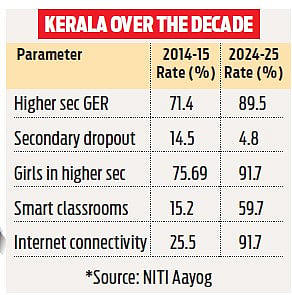
Kerala has emerged as a frontrunner in higher secondary education, registering a robust 89.5% Gross Enrolment Ratio (GER) for Plus-I enrolment in 2024-25, according to a pivotal NITI Aayog report. This impressive figure positions the state just shy of top-performing Union Territories like Chandigarh, Puducherry, and Goa, highlighting a significant improvement of over 18 percentage points from its 2014-15 GER of 71.4%. The achievement underscores Kerala's sustained commitment to accessible education amidst national challenges in student retention. The 'School Education System in India: Temporal Analysis and Policy Roadmap for Quality Enhancement' report, released in May 2026, details India's struggle with escalating dropout rates, particularly at the secondary to higher secondary level, where the national GER for the higher secondary sector stands at a mere 58.4%. In stark contrast, Kerala has not only boosted overall enrolment but also achieved a notable 91.7% participation rate for girls in higher secondary education, significantly outpacing the national average of 60.9%. This success is attributed to robust public education infrastructure, widespread school networks, and proactive government policies that mitigate the financial burdens often leading to student withdrawals. Looking ahead, Kerala's state budget for 2026 includes progressive reforms such as free education up to the graduate level and the establishment of an Academic Syndicate to streamline higher education governance, signaling continued investment. The state is also launching 'Nehru Centres of Scientific Temper' to cultivate critical thinking, aligning with the broader national vision of 'Viksit Bharat @2047' through human capital development. These initiatives reflect a strategic blueprint for educational excellence, setting a high bar for other states grappling with the complexities of India's fragmented educational pipeline.