India's Cancer Data Crisis: Telangana's Move Reignites National Notifiable Disease Debate
Context mode is active. Hover over any highlighted term to see its definition. Click a nested term to go deeper.
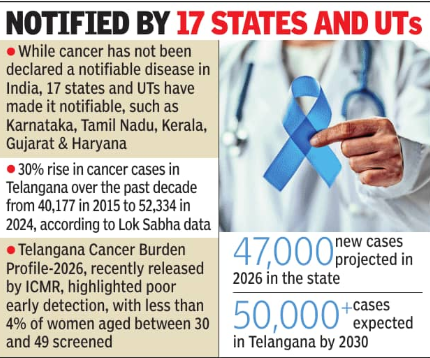
India's fight against a surging cancer epidemic faces a critical hurdle: a severe lack of comprehensive data. This issue came sharply into focus after Telangana, in April 2026, mandated cancer as a Notifiable Disease, making it the 17th state to do so and reigniting calls for a similar nationwide directive from the Union Government. Without a uniform national reporting system, India is currently underestimating the true scale of its cancer burden, hindering effective public health planning and resource allocation. The existing National Cancer Registry Programme (NCRP) relies on Population-Based Cancer Registries (PBCRs) and Hospital-Based Cancer Registries (HBCRs), which collectively cover only about 10-18% of the population, primarily in urban areas, and often miss data from the crucial private healthcare sector. This patchy data collection is alarming, especially as the Global Cancer Observatory (GLOBOCAN) projects India's cancer cases to surge by 74% from 1.41 million in 2022 to 2.46 million by 2045. Despite recommendations from the Indian Council of Medical Research (ICMR) since 2008 and a Parliamentary Standing Committee in 2022 and again in August 2025, the Union Health Ministry has maintained that cancer, being a Non-Communicable Disease (NCD), does not require national notification. Moving forward, a national mandate would create a robust, real-time cancer database, essential for identifying regional hotspots, tailoring prevention campaigns, and strengthening cancer control programmes. While the Union Budget 2025-26 introduced initiatives like Day Care Cancer Centres and customs duty exemptions for certain cancer drugs, these efforts will only reach their full potential with accurate, complete data. The Centre needs to learn from states like Telangana and recalibrate its approach to ensure every cancer case is counted, enabling a truly evidence-based national strategy for prevention, early detection, and affordable treatment.