Brain's Hidden Timer for Smell Unlocked, Explaining Rapid Odor Detection
Context mode is active. Hover over any highlighted term to see its definition. Click a nested term to go deeper.
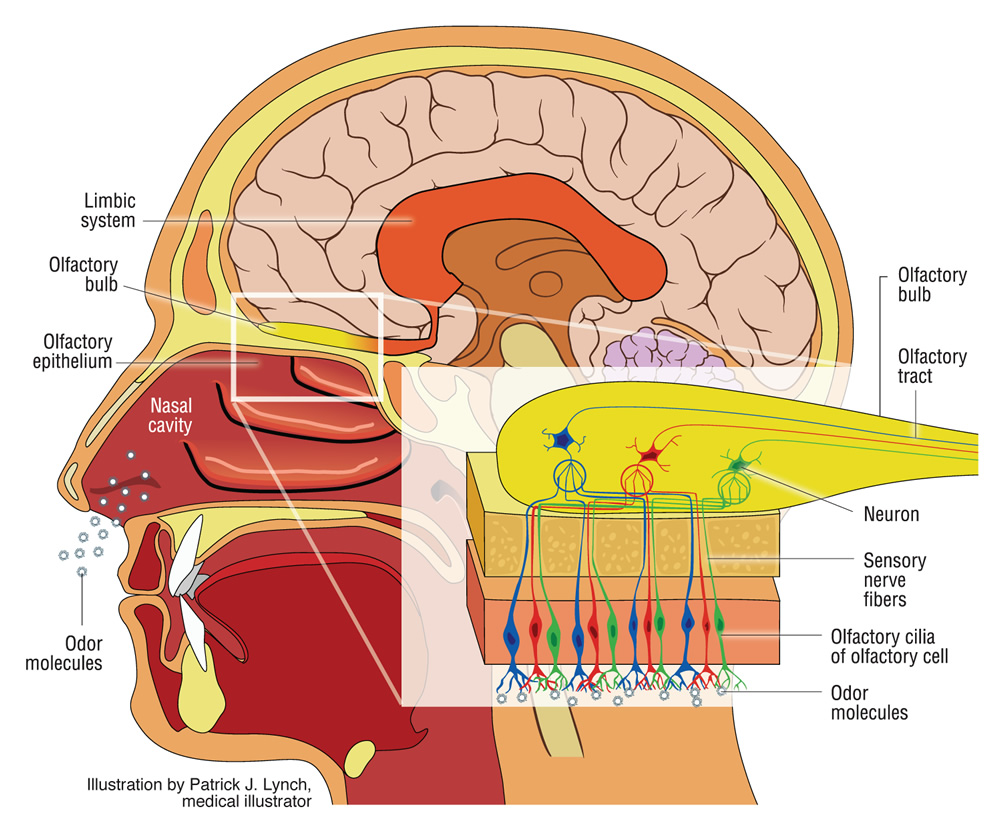
Researchers at Northwestern University have cracked a long-standing mystery of our senses, revealing that a hidden 'timer' in the human brain's olfactory bulb allows us to identify smells almost instantly despite our slow sniffing. Published recently in Science Advances, this groundbreaking discovery shows that each deliberate sniff triggers a unique internal rhythm, much like a clock, that precisely organizes smell information. This explains how humans can recognize a scent as quickly as fast-sniffing animals, overturning previous ideas about how our sense of smell truly works. For decades, scientists puzzled over the 'sniffing paradox': how humans, with their long, slow inhalations, could match the rapid odor identification of animals like mice, which sniff many times a second. This new research shows that our brain's olfactory bulb generates 'theta oscillations' – slow, powerful brain waves – that act as this internal clock, synchronizing faster bursts of brain activity to process the smell. Adding to this, a separate study from NYU Langone Health, published in Nature Neuroscience, found that the olfactory bulb performs 'temporal filtering', identifying odors within the first 50 milliseconds of a sniff by prioritizing early signals and blocking out background noise. This combined understanding suggests that the olfactory bulb, not the conscious cerebral cortex, is the rapid decision-maker for what we smell, a crucial insight into how all mammals process scents. This breakthrough could have big implications beyond just understanding smell. It offers new avenues for studying and potentially treating neurodegenerative disorders like Alzheimer's and Parkinson's, where loss of smell is often an early symptom. Scientists will now explore the exact origin of these brain rhythms – whether they come from higher brain regions or directly from the nose – and how these mechanisms could inspire more efficient AI systems for sensory processing. The race is on to unlock more secrets of our senses and apply these findings to human health and technology.