Cosmic First: Three-Lobed Asteroid with Orbiting Moon Stuns Astronomers
Context mode is active. Hover over any highlighted term to see its definition. Click a nested term to go deeper.
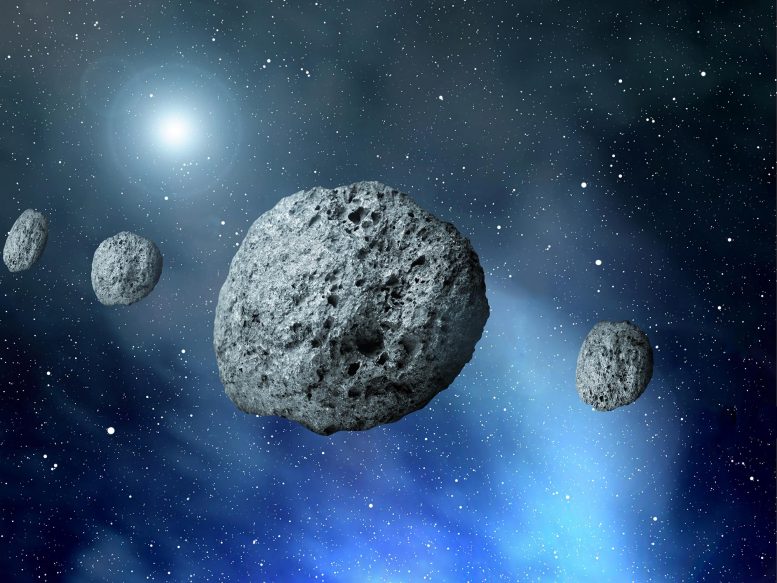
Astronomers have just unveiled a truly bizarre discovery in our Solar System: 44 Nysa, an asteroid confirmed to be the first ever found with a distinct three-lobed, or 'trilobite,' shape, and it even has its own tiny moon, now named S/2026 (44) 1. This groundbreaking observation challenges long-held ideas about how these space rocks form and evolve, offering a fresh look into the violent early days of our planetary neighborhood. This unique celestial body, located in the main Asteroid belt between Mars and Jupiter, has been observed since 1857, but its true, complex form remained a mystery until now. Researchers, led by Kate Minker of Lowell Observatory, used powerful telescopes like the Large Binocular Telescope (LBT) and the Very Large Telescope (VLT) with advanced adaptive optics and high-contrast imaging techniques to finally get clear pictures of 44 Nysa. Its unusual E-type asteroid composition and density suggest it could be a 'contact trinary' – three components gently stuck together, or an incredibly irregular, single body formed from ancient collisions. The discovery of 44 Nysa three-lobed structure and its tiny companion, S/2026 (44) 1, opens new avenues for planetary science, especially in understanding how asteroids are built and how they might preserve materials from the early Solar System. Future observations of the moon's orbit will help scientists figure out Nysa's exact mass and density, which could give us crucial clues about the formation of Earth and other inner planets billions of years ago.