Cosmic Neutrino Hunter Francis Halzen Wins 2026 Physics Nobel for Antarctic Ice Telescope
Context mode is active. Hover over any highlighted term to see its definition. Click a nested term to go deeper.
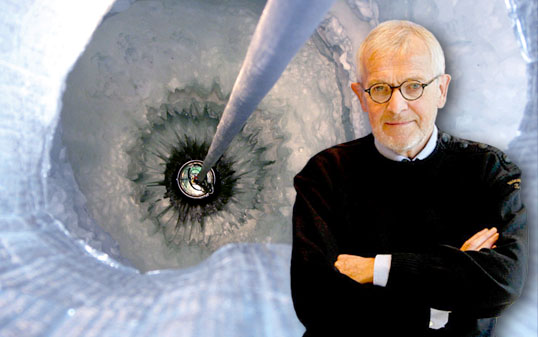
The Royal Swedish Academy of Sciences has awarded the 2026 Nobel Prize in Physics to Professor Francis Halzen for his groundbreaking leadership of the IceCube Neutrino Observatory, which successfully detected high-energy cosmic neutrinos from deep space. Halzen's visionary idea to transform a cubic kilometer of Antarctic ice into a giant particle detector has unveiled a completely new way to 'see' the universe, offering a fresh lens beyond traditional light and gravitational waves. This monumental achievement marks the birth of neutrino astronomy, a field poised to unlock secrets of the most violent cosmic events. This isn't just about a prize; it's about pioneering a new era of understanding. Neutrinos, often called 'ghost particles' due to their elusive nature, rarely interact with matter, making them perfect messengers from extreme environments like exploding stars and black holes, as they travel almost undisturbed across vast cosmic distances. The IceCube experiment, completed in 2011, uses thousands of Digital Optical Modules (DOMs) buried deep within the South Pole glacial ice to capture faint flashes of blue light – known as Cherenkov radiation – produced when a neutrino rarely collides with an atomic nucleus. Canada's SNOLAB, an underground research facility, is also playing a critical role, currently testing new DOMs for IceCube and boasting strong ties, as its Executive Director, Dr. Jodi Cooley, was a former mentee of Halzen. Looking ahead, the IceCube Neutrino Observatory is not resting on its laurels; an 'IceCube Upgrade' has been installed to further improve detection capabilities, allowing for the study of lower-energy neutrinos and better pinpointing their origins. This ongoing research promises to deepen our understanding of particle accelerators in space, the fundamental properties of neutrinos themselves, and perhaps even reveal physics beyond the Standard Model. The ability to observe the universe through these 'ghostly' particles ensures that the hunt for cosmic mysteries is just beginning, with many more discoveries expected to follow.