Earth's Ice Sheets Vanish at Alarming Rate, Fueling Global Sea-Level Rise
Context mode is active. Hover over any highlighted term to see its definition. Click a nested term to go deeper.
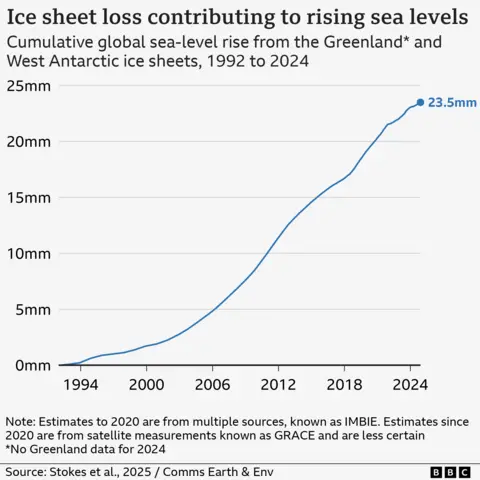
The Earth has shed an astounding 11.3 trillion metric tonnes of ice from its two largest ice sheets – Greenland and Antarctica – between 1979 and 2023, directly contributing 3.14 centimeters to global sea-level rise. This stark finding, revealed by an international team of polar scientists using decades of satellite data, confirms an accelerating crisis. The pace of ice loss quadrupled from the 1980s to the 2010s, with experts warning this trend puts millions at immediate risk of coastal flooding. This isn't just about warmer air; the new research highlights that 84% of this massive ice loss comes from glaciers speeding up as they flow into the ocean, not merely from surface melting. This points to dangerously warming ocean temperatures eroding ice from below, a far more challenging problem to reverse. While a temporary slowdown was observed between 2020 and 2023 due to unusual snowfall and milder summers in some regions, scientists emphasize this is a short-term variation, not a reversal of the long-term, human-driven climate change trend. Looking ahead, the implications are dire: the lost ice accounts for roughly a quarter of all global sea-level rise, with every additional centimeter threatening 2 to 3 million more people with annual coastal flooding. As polar ice continues to recede, projections suggest global sea levels could surge by up to two meters by 2100 under high emission scenarios, exacerbating 'sunny day flooding' and storm surges in vulnerable coastal cities worldwide. The urgent need for drastic climate action becomes clearer with every vanishing tonne of ice.