Graphene neural interface enables two-way communication with the brain - Nanowerk
Context mode is active. Hover over any highlighted term to see its definition. Click a nested term to go deeper.
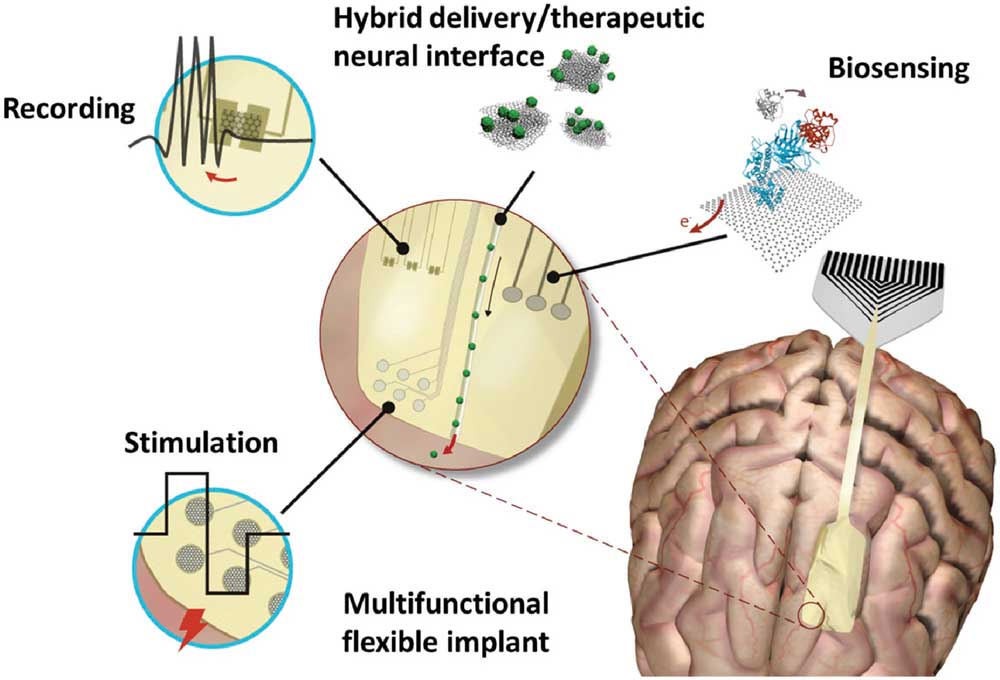
A groundbreaking graphene neural interface has achieved simultaneous two-way communication with the brain, a major leap that could revolutionize treatment for neurological disorders. Developed by researchers at the Institute of Microelectronics of Barcelona (IMB-CNM-CSIC) and the Catalan Institute of Nanoscience and Nanotechnology (ICN2), the device, detailed in a recent Nature Communications study, integrates both highly sensitive recording and precise stimulation capabilities into a single, flexible platform, overcoming critical limitations of current unidirectional brain implants. This innovation directly addresses the inadequacy of existing clinical implants, like those used for Parkinson's disease or epilepsy, which often operate with fixed parameters and fail to adapt to dynamic changes in brain activity. The flexible graphene-based system utilizes monolayer graphene transistors (gFETs) for ultra-low frequency brain signal recording and nanoporous reduced graphene oxide (rGO) microelectrodes for targeted electrical stimulation, enabling a level of precision previously hampered by signal interference. This breakthrough comes as neurotechnology, encompassing brain-computer interfaces (BCIs) and neuromodulation, is experiencing rapid growth, with the global market projected to reach $25.4 billion by 2030, driven by investment in advanced neural implants and AI-driven diagnostics. Notably, Barcelona-based INBRAIN Neuroelectronics, a spin-off from ICN2 and IMB-CNM, has already completed patient enrollment in its first-in-human study of a graphene cortical interface, reporting no device-related adverse events as of April 2026. With preclinical trials demonstrating superior performance over conventional electrodes and the successful safety profile in initial human studies, the immediate next steps involve advancing these graphene neural interface towards broader clinical use. Companies like INBRAIN Neuroelectronics are working to commercialize these high-resolution, adaptive neuroelectronic treatments, potentially transforming therapies for conditions ranging from epilepsy and Parkinson's disease to stroke rehabilitation and even speech decoding. The challenge now lies in navigating stringent regulatory pathways and scaling production, while ethical considerations around brain data privacy and long-term societal impact will remain a critical watchpoint for this rapidly evolving frontier of human-machine interaction.