Japan Embarks on Historic Mission to Unravel Martian Moons' Secrets
Context mode is active. Hover over any highlighted term to see its definition. Click a nested term to go deeper.
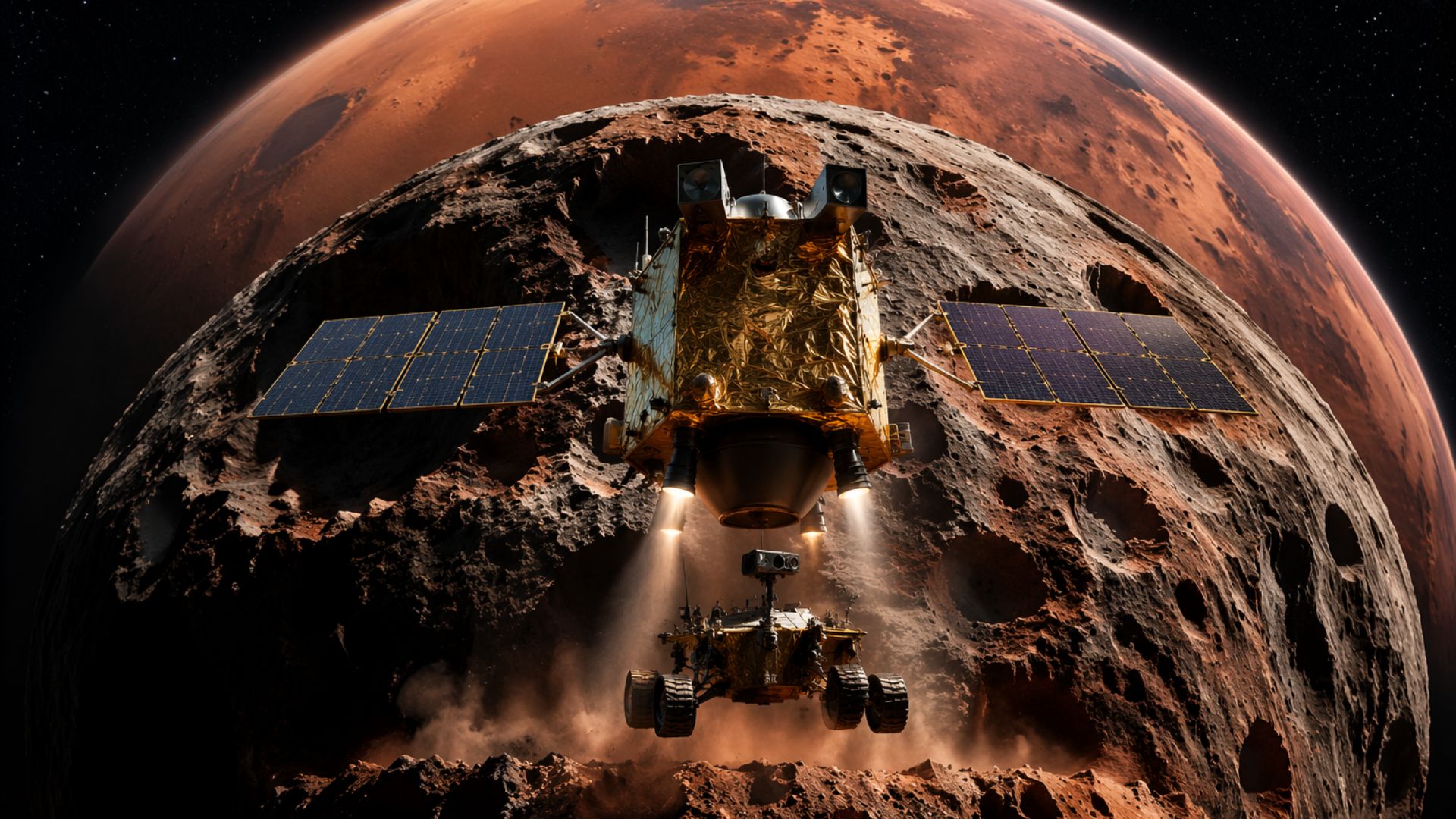
Japan is set to make history by launching its Martian Moons eXploration (MMX) mission this week, aiming to bring back samples from Phobos, Mars' larger and more mysterious moon. The Japan Aerospace Exploration Agency (JAXA) plans for the MMX spacecraft to blast off from the Tanegashima Space Center on October 19 (UTC) aboard the H3 rocket, embarking on a five-year journey to unlock profound questions about our Solar System and the origins of life itself. This ambitious undertaking, a global collaboration involving NASA, ESA, CNES, and DLR, marks the world's first sample return mission from the Martian system. The MMX mission is designed to shed light on the contentious origin of Phobos and its smaller sibling, Deimos, probing whether they are captured asteroids or remnants from an ancient impact on Mars. The spacecraft will arrive at Mars in August 2027, then spend three years studying Phobos from a unique Quasi-Satellite Orbit before deploying the French-German Idefix rover in early 2029 to scout landing sites. Subsequently, the main MMX craft will attempt two landings in 2030 to collect at least 10 grams of regolith using both a JAXA corer and a NASA-provided Pneumatic Sampler. If successful, the samples are expected to return to Earth in 2031, landing in Australia for recovery and analysis by an international team of scientists. This mission is not just about Martian moons; it's a critical step in developing technologies for future human exploration to Mars, particularly navigating the planet's significant 'gravity well.' The data and samples could revolutionize our understanding of planetary formation, the evolution of Mars, and the distribution of water and organic materials in the early Solar System, offering clues to how Earth became a life-sustaining planet.