New study says comet 3I/ATLAS might be oldest interstellar visitor ever - Yahoo
Context mode is active. Hover over any highlighted term to see its definition. Click a nested term to go deeper.
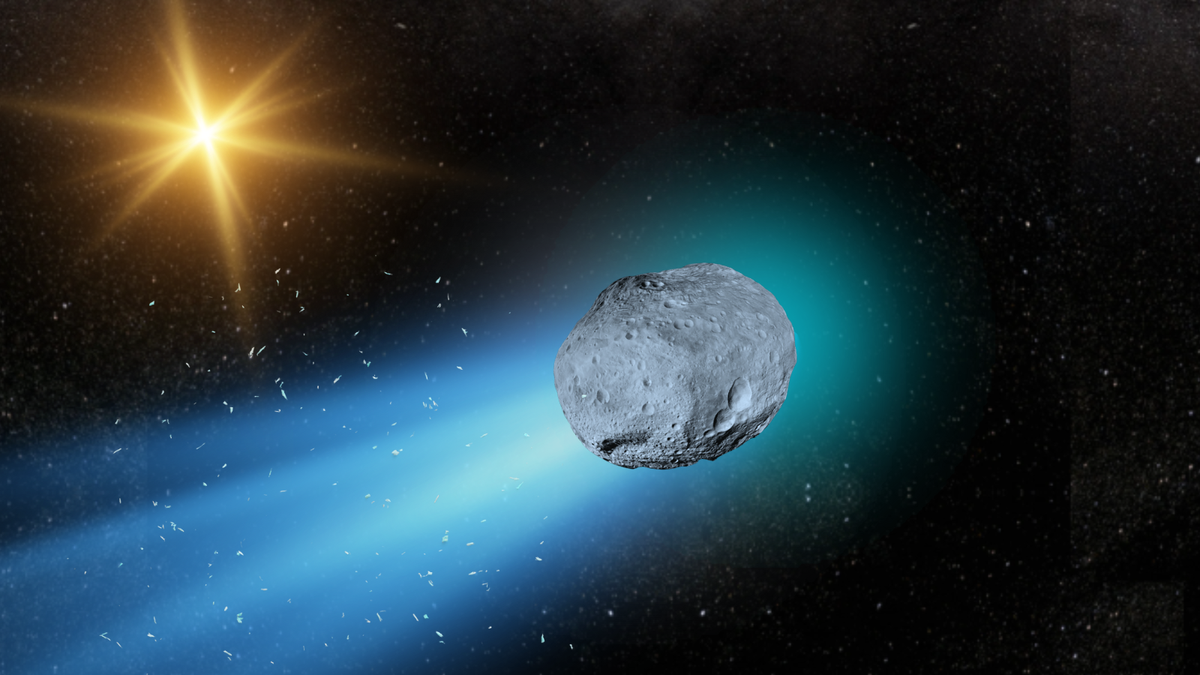
Astronomers are buzzing after new studies, published on June 22, 2026, revealed that Comet 3I/ATLAS, a visitor from beyond our Solar System, might just be the oldest object ever seen in our cosmic neighborhood, possibly dating back 10 to 12 billion years. This makes the exocomet nearly three times older than our own Solar System, offering an unprecedented look into the very early universe. The crucial insights came from the James Webb Space Telescope (JWST), which analyzed the comet's chemical makeup after its close pass by the Sun in late 2025. What makes 3I/ATLAS so ancient? Webb's NIRSpec instrument detected exceptionally high levels of Deuterium – a heavier form of hydrogen – roughly 30 times more than typically found in comets formed within our Solar System. This, along with low amounts of Carbon-13, strongly suggests it originated in a very cold, primitive region of the galaxy during a period known as 'Cosmic Noon,' when star formation was at its peak. Discovered on July 1, 2025, by the ATLAS Survey Telescope, 3I/ATLAS is only the third confirmed Interstellar Object to traverse our Solar System, following 'Oumuamua and 2I/Borisov, but its brightness allowed for detailed spectroscopic analysis unlike its predecessors. As Comet 3I/ATLAS now moves away from the Sun on its Hyperbolic Trajectory, never to return, scientists are poring over the data to understand the conditions of other planetary systems and the chemical building blocks available in the early universe. This unique 'time capsule' allows us to compare our Solar System formation to much older stellar nurseries, potentially reshaping our understanding of how common or uncommon the ingredients for life truly are across the cosmos. Expect more detailed analyses and comparative studies in the coming months as researchers decode its secrets.