Scientists Say Supermassive Black Holes Could Be Surrounded by Millions of Planets - ZME Science
Context mode is active. Hover over any highlighted term to see its definition. Click a nested term to go deeper.
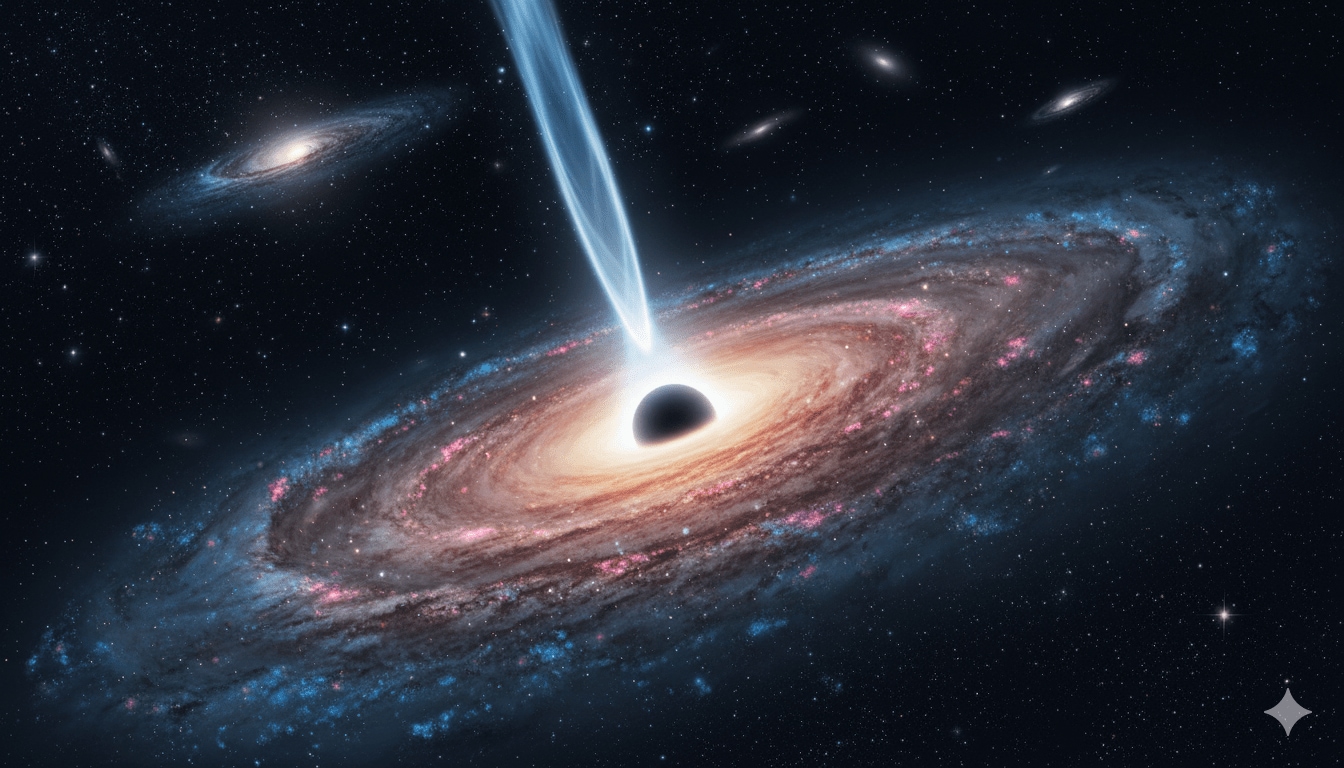
A new theoretical framework, backed by advanced astrophysical simulations, indicates that millions of planets, potentially dubbed "ergo-planets," could form within the turbulent, gas-rich accretion disks encircling supermassive black holes. This groundbreaking research, recently highlighted by a consortium of international astrophysicists, fundamentally reconfigures our understanding of cosmic nurseries, suggesting that planetary abundance extends far beyond stellar systems into the most extreme environments of the universe. Traditionally, planet formation was understood to occur primarily in protoplanetary disks around young stars, relying on stellar light and the gradual accumulation of dust and gas. However, the latest models propose that within the colder, outer regions of a supermassive black hole's accretion disk, where dense gas and dust are shielded from intense radiation, gravitational instabilities could trigger the rapid collapse of matter into planetesimals. These conditions, surprisingly conducive to formation, could explain the prevalence of such planets even around entities like Sagittarius A* at the heart of our own Milky Way. The immediate next steps involve refining these complex simulations and, crucially, developing observational strategies capable of detecting indirect evidence of these "black hole planets." While direct imaging remains a distant prospect, future deep-space observatories and advances in radio astronomy, building on the capabilities of projects like the Event Horizon Telescope, might someday discern gravitational perturbations or unique spectral signatures. This opens a new frontier for astrobiology, challenging preconceived notions about the prerequisites for planetary existence.