Sitharaman, Standard Chartered CEO Chart Course for India's Global Financial Hub Ambitions
Context mode is active. Hover over any highlighted term to see its definition. Click a nested term to go deeper.
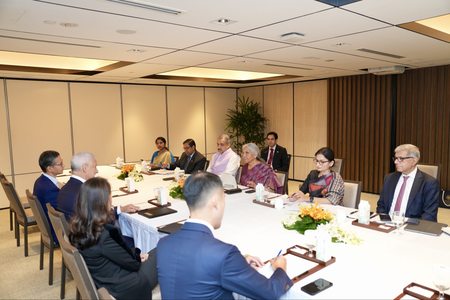
India's Finance Minister Nirmala Sitharaman recently met with Standard Chartered Bank Group Chief Executive Bill Winters in Singapore to strategize on bolstering trade finance and cross-border banking, aiming to accelerate India's growing integration with global markets. This high-level discussion, also involving Standard Chartered's Group COO Tanuj Kapilashrami, underscores India's aggressive push to position itself as a major international financial and manufacturing powerhouse, leveraging its economic momentum and digital infrastructure. The talks come as India's trade finance market forecasts robust growth, projected to hit $4.09 billion by 2031, driven by government export schemes and a maturing digital payments backbone. Standard Chartered has been a key player in this evolution, notably processing the world's first real-time cross-border remittance to India in a mere 37 seconds in July 2026, demonstrating advancements in financial flows. Bill Winters has consistently highlighted the bank's focus on cross-border banking in high-growth markets like India, while Minister Sitharaman continues to champion initiatives like 'Make in India' and attract foreign investment across diverse sectors, including infrastructure and digital technologies. Looking ahead, the dialogue signals potential new avenues for collaboration, particularly around the adoption of artificial intelligence in banking, the establishment of treasury centres at GIFT IFSC, and exploring emerging financial instruments like tokenization and Central Bank Digital Currencies. With new Foreign Exchange Management Act regulations also effective October 1, 2026, the discussions are poised to shape India's financial landscape, making it easier and more efficient for global capital to flow in and out, supporting India's ambition to navigate persistent global economic uncertainties.