The Webb telescope has captured its first 'bulge fossil fragment'
Context mode is active. Hover over any highlighted term to see its definition. Click a nested term to go deeper.
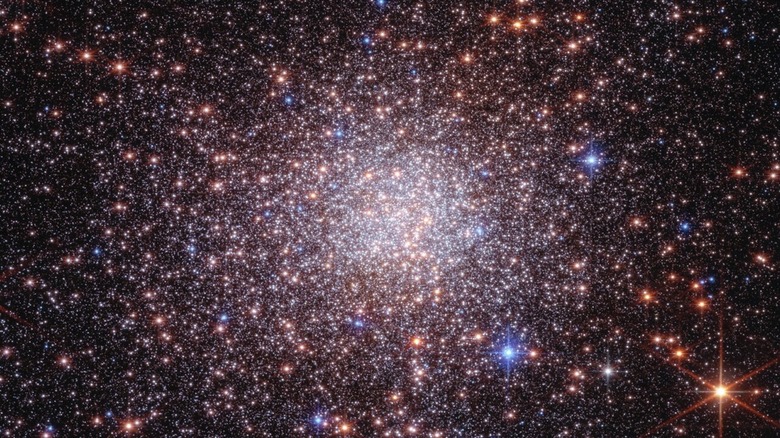
The James Webb Space Telescope, in a groundbreaking collaboration with the Hubble Space Telescope, has identified a celestial body previously misclassified as a globular star cluster: Terzan 5 has been revealed as a 'bulge fossil fragment,' offering unprecedented insight into the violent, chaotic birth of galactic bulge and, by extension, our own Milky Way galaxy. This reclassification, announced by researchers on June 16, 2026, overturns decades of astronomical understanding and provides direct observational evidence for how the central, densely packed regions of galaxies form. This discovery is not merely a name change; it fundamentally alters the narrative of galactic evolution. Terzan 5, located within the Milky Way central bulge, has now been shown to host at least four distinct stellar populations, ranging in age from 12.5 billion to 2.5 billion years old, a stark contrast to typical globular clusters that contain only one ancient generation of stars. This multi-generational star formation activity within a self-contained stellar system suggests Terzan 5 is a remnant of primordial clumps that merged to form the galactic bulge, rather than a singular, unevolving cluster. This challenges existing models of early galaxy formation, which often assumed a more orderly process. The implications are profound, suggesting the Milky Way central region grew not just from gradual accumulation but from the violent merging of such resilient 'fossil fragments.' Researchers are now poised to examine other globular-cluster-like systems within the galactic bulge, with Liller 1 already identified as another potential bulge fossil fragment, to uncover more of these cosmic relics. This ongoing work, spearheaded by teams including those from the University of Bologna, promises to further refine our understanding of cosmic dawn and the evolutionary pathways that shaped the galaxies we see today.